
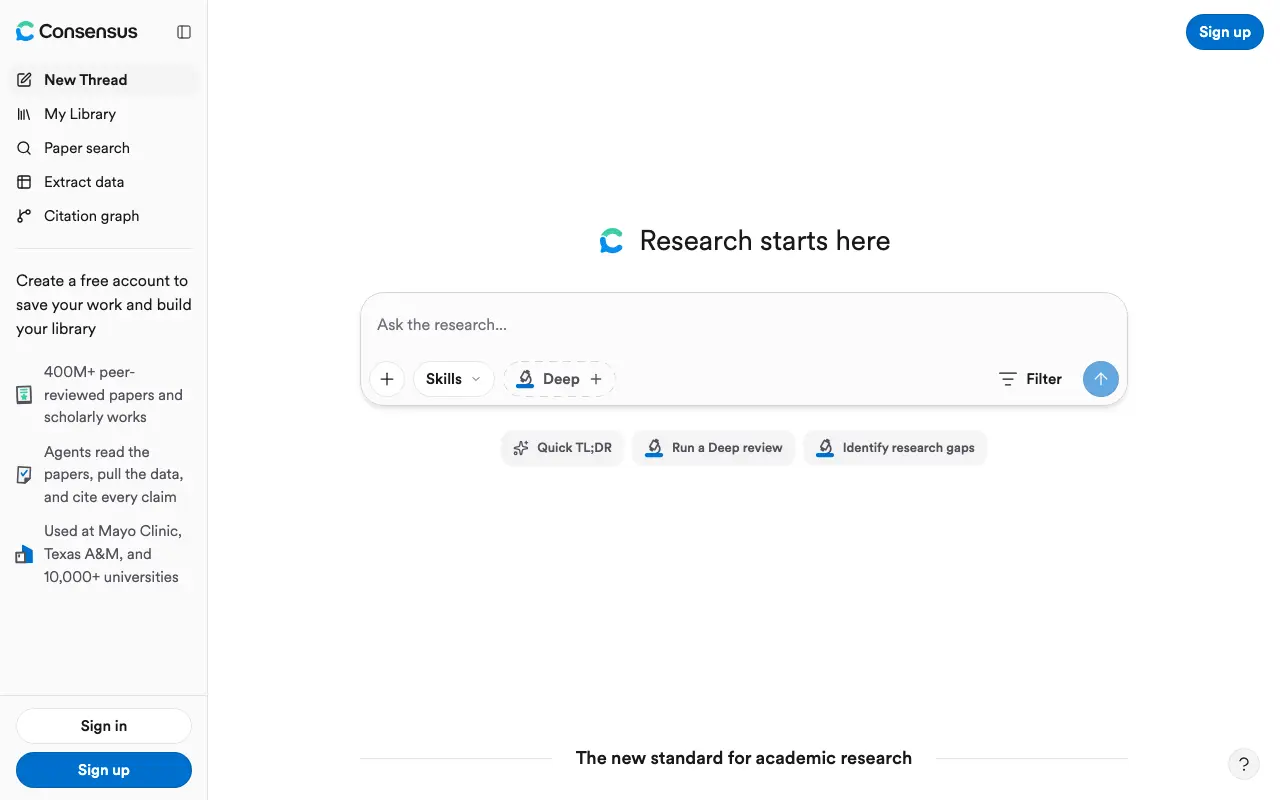
What is Consensus?
Consensus is an AI academic search engine designed to help researchers navigate peer-reviewed literature. It draws on a database of over 400 million scholarly works, including licensed full-text content from various leading publishers. The platform aims to provide evidence-based answers to research questions by pulling data directly from scientific papers.
Users can interact with the tool using natural language queries. The system uses agents to read papers, extract relevant data, and cite every claim made in its responses. This approach is intended to maintain academic rigor while speeding up the literature review process.
How Consensus works
Users enter a research question or topic into the search bar using natural language. The tool then searches its database of peer-reviewed papers to find relevant studies. It can apply specific filters such as timeframes, study populations, or research designs. For more complex tasks, the Deep Search feature builds a comprehensive strategy by expanding terms and exploring citation graphs to identify conflicting arguments or research gaps.
Consensus key features
- Search 400M+ peer-reviewed scholarly works
- Deep Search for comprehensive literature reviews
- Consensus Meter to visualize evidence agreement
- Medical mode for clinical guidelines and journals
- Natural language filters for study design and population
- Automated data extraction with citations
- Citation graph exploration
Who Consensus is for
Consensus pros and cons
Pros
- Direct access to 400 million scholarly works
- Provides visual indicators of scientific agreement
- Includes licensed full-text content from publishers
Cons
- Results are limited to published peer-reviewed literature
- Requires specific query types for best results
Consensus pricing
Freemium. Users can create a free account to save work and build a library.
Prices last checked November 23, 2026. Always confirm on the official Consensus website.
Consensus FAQ
Is Consensus free?
The website mentions creating a free account to save work, but specific pricing tiers are not detailed on the page.
What is Consensus used for?
It is used for searching, organizing, and analyzing peer-reviewed scientific literature.
Does Consensus provide citations?
Yes, the AI agents cite every claim they pull from the research papers.
How many papers are in the database?
The platform draws on over 400 million peer-reviewed papers and scholarly works.