
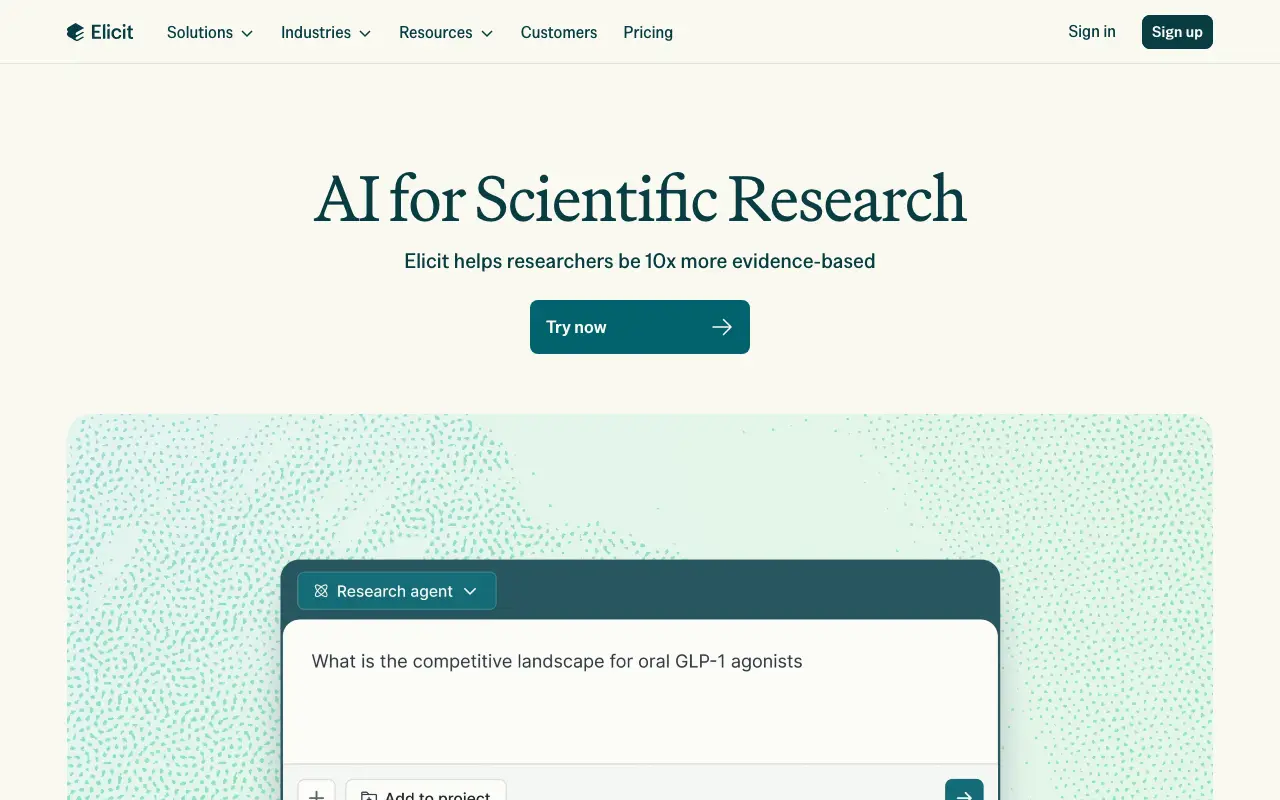
What is Elicit?
Elicit is an AI research assistant built to help scientists and researchers navigate large volumes of academic literature. It uses semantic search to find relevant papers from over 138 million academic documents and 545,000 clinical trials without requiring specific keywords.
Beyond simple search, the platform functions as a research agent that can gather evidence from scientific databases, journals, and uploaded documents. It provides structured outputs like tables, figures, and reports to help users understand the existing scientific landscape more quickly.
How Elicit works
A researcher enters a research question or topic into the interface. Elicit searches through its database of academic papers and clinical trials to find relevant evidence. The system then analyzes the findings to generate structured research reports, interactive tables, or custom extractions, providing sentence-level citations for every claim made to ensure transparency and accuracy.
Who should use Elicit?
Elicit is designed for professionals in academia, pharmaceuticals, medical technology, and government policy. It is particularly useful for researchers conducting systematic literature reviews, scientists designing new experiments, and industry professionals needing to weigh tradeoffs based on existing scientific evidence.
Our take
Elicit offers a significant advantage for researchers by automating time-consuming tasks like data extraction and screening, which can lead to substantial time savings. Its ability to provide sentence-level citations helps maintain scientific rigor. However, while the tool is highly specialized for scientific text, users must still verify the AI-generated summaries against the original source material to ensure complete accuracy in high-stakes environments.
Elicit key features
- Semantic search across 138 million academic papers
- Automated systematic literature review screening
- Generation of cited research reports and briefs
- Data extraction from uploaded documents and journals
- Elicit Routines to monitor new research updates
- Interactive tables for analyzing multiple data points
- API and MCP server access for custom workflows
Who Elicit is for
Elicit pros and cons
Pros
- Provides sentence-level citations for transparency
- Automates data extraction from large datasets
- Supports large-scale analysis of up to 20,000 data points
Cons
- Requires manual verification of AI-generated claims
- Advanced features like real-time collaboration require higher-tier plans
Elicit pricing
Freemium, paid plans from $49. Plans range from a free Basic tier to a Pro plan at $49 per user/month billed annually.
Prices last checked November 23, 2026. Always confirm on the official Elicit website.
Elicit FAQ
Is Elicit free?
Elicit offers a Basic plan that is free with limited usage for the Research Agent and Research Reports.
What data sources does Elicit have access to?
Elicit searches over 138 million academic papers and 545,000 clinical trials.
Can I use my own documents?
Yes, Elicit can gather evidence from internally uploaded documents.
Does Elicit provide citations?
Yes, Elicit supports all AI-generated claims with sentence-level citations from the underlying sources.